Ask our dispensing opticians

Ask Now

SmartBuyGlasses Lens Packages Explained

By SmartBuyGlasses Editorial Team
Reviewed by Karen Apuan

Karen Apuan

Reviewed by

Karen Apuan
Karen holds a Doctor of Optometry degree and is a member of the Integrated Philippine Association of Optometrists. Before becoming an optometrist, she gained over 6 years of experience as an ophthalmic technician in her home country.
The right glasses lens package depends on four things: your prescription, your frame, what the package includes and the total price.
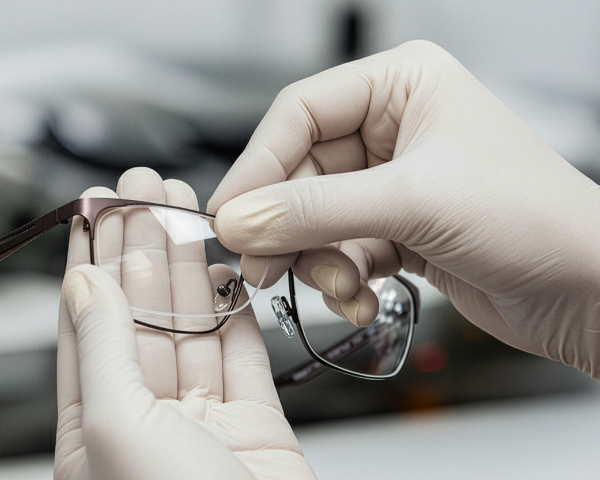
prescription lens being inserted into eyeglasses

SmartBuyGlasses offers two ranges, Essential and Clarity, and each comes in several indices. The index tells you how much a lens bends light, and so how thin it can be.

Which lens packages does SmartBuyGlasses offer?

SmartBuyGlasses offers nine glasses lens packages on the UK site: five Essential and four Clarity. 

The Standard single-vision lens is included with every frame. The other packages cost extra. 

The table below shows what each package includes. SPH (sphere) indicates your short-sightedness and/or long-sightedness, while CYL (cylinder) indicates the lens power needed to correct astigmatism. For more details, visit the page on how to read your eye prescription.

Package

Range

Index

Material and design

Recommended prescription range

Coatings included

Standard

Essential

1.5

CR-39, spherical

SPH ±2.75, CYL up to ±2.00

None

Comfort

Essential

1.5

CR-39, spherical

SPH ±2.75, CYL up to ±2.00

Scratch-resistant, anti-reflective

Thin & Light

Essential

1.61

MR-8, aspheric

SPH +4.25 to -5.00, CYL up to ±3.00

Scratch-resistant, anti-reflective, UV400

Ultra

Essential

1.67

MR-7 or MR-10, aspheric

SPH +7.00 to -8.00, CYL up to ±4.00

Scratch-resistant, anti-reflective, UV400, super-hydrophobic

Deluxe

Essential

1.74

MR-174, aspheric

SPH +10.00 to -14.00, CYL up to ±6.00

Scratch-resistant, anti-reflective, UV400, super-hydrophobic

Clarity Active-X

Clarity

1.5

CR-39, aspheric

SPH ±2.75, CYL up to ±2.00

Scratch-resistant, anti-reflective, UV400, super-hydrophobic, Impact X

Clarity Pro-X

Clarity

1.61

MR-8, aspheric

SPH +4.25 to -5.00, CYL up to ±3.00

Scratch-resistant, anti-reflective, UV400, super-hydrophobic, Impact X

Clarity Ultra-X

Clarity

1.67

MR-7 or MR-10, aspheric

SPH +7.00 to -8.00, CYL up to ±4.00

Scratch-resistant, anti-reflective, UV400, super-hydrophobic, Impact X

Clarity Elite-X

Clarity

1.74

MR-174, aspheric

SPH +10.00 to -14.00, CYL up to ±6.00

Scratch-resistant, anti-reflective, UV400, super-hydrophobic, Impact X

Package

Range

Index

Recommended prescription range

Coatings included

Standard

Essential

1.5

SPH ±2.75, CYL up to ±2.00

None

Comfort

Essential

1.5

SPH ±2.75, CYL up to ±2.00

Scratch-resistant, anti-reflective

Thin & Light

Essential

1.61

SPH +4.25 to -5.00, CYL up to ±3.00

Scratch-resistant, anti-reflective, UV400

Ultra

Essential

1.67

SPH +7.00 to -8.00, CYL up to ±4.00

Scratch-resistant, anti-reflective, UV400, super-hydrophobic

Deluxe

Essential

1.74

SPH +10.00 to -14.00, CYL up to ±6.00

Scratch-resistant, anti-reflective, UV400, super-hydrophobic

Clarity Active-X

Clarity

1.5

SPH ±2.75, CYL up to ±2.00

Scratch-resistant, anti-reflective, UV400, super-hydrophobic, Impact X

Clarity Pro-X

Clarity

1.61

SPH +4.25 to -5.00, CYL up to ±3.00

Scratch-resistant, anti-reflective, UV400, super-hydrophobic, Impact X

Clarity Ultra-X

Clarity

1.67

SPH +7.00 to -8.00, CYL up to ±4.00

Scratch-resistant, anti-reflective, UV400, super-hydrophobic, Impact X

Clarity Elite-X

Clarity

1.74

SPH +10.00 to -14.00, CYL up to ±6.00

Scratch-resistant, anti-reflective, UV400, super-hydrophobic, Impact X


The higher the index, the thinner the lens can be.

At the same index, Clarity adds Impact X to the Essential coatings. At 1.5 it also adds UV400, super-hydrophobic and an aspheric design compared to Comfort, and at 1.61 it adds super-hydrophobic.

What extras can I add?

The coatings that come with each package are listed in the first table above. Anything else is an add-on, chosen at the last step of checkout. Clear lenses are included with every package.

Add-on

What it does

zFORT® Blue Light

Filters blue light from digital screens

Transitions® and photochromic

Darken in bright sunshine and clear indoors

Colour tint

A full, gradient or fashion tint in dark (80%), medium (50%) or light (30%)

Polarised

Reduces glare, in grey or brown

Mirrored

A reflective finish in silver, gold, blue, green or red

Essential and Clarity lenses: what is the difference?

Essential lenses are our core range. Every Clarity lens is aspheric, meaning it has a flatter curve towards the edges than a standard lens. This helps the lenses look slimmer and less bulging. Clarity lenses also include a set of built-in treatments at the same index. Both ranges let you choose your preferred thickness, so let’s start by understanding lens index.

What does lens index mean?

Lens index describes how strongly a material bends light. A higher index bends light more, so the same prescription needs less material and the lens can be thinner. The difference shows most with stronger prescriptions, where a low-index lens can be noticeably thick: at the edges for short-sighted prescriptions, or in the centre for long-sighted ones. With a low prescription, a higher index may make little visible difference.

Index is only one part of the picture. Frame size, how far the lens sits from your eye and where your pupils sit in the frame all affect how thick the finished lens looks.

What are the lenses made of?

All the packages above use ophthalmic lenses. The 1.5 lenses are CR-39 plastic, the standard lens material for basic prescriptions. It is light, takes tints well and corrects most everyday prescriptions. The 1.61, 1.67 and 1.74 lenses are high-index plastics. The 1.61 lenses use MR-8. The 1.67 lenses use MR-7 or MR-10, and the 1.74 lenses use MR-174. 

All of these provide the same optical correction in a thinner, lighter lens. They are designed for stronger prescriptions, and 1.74 is the thinnest option. See our lens materials guide for a fuller comparison.

Essential lenses (1.5, 1.61, 1.67 and 1.74)

Essential lenses come in five packages: Standard and Comfort (both 1.5), Thin & Light (1.61), Ultra (1.67) and Deluxe (1.74). Thin & Light, Ultra and Deluxe are aspheric. Standard and Comfort are not. Coatings step up with the index, as the first table shows.

Clarity lenses (Active-X, Pro-X, Ultra-X and Elite-X)

Clarity lenses are built for durability. Every Clarity package is aspheric, includes scratch-resistant, anti-reflective, UV400 and super-hydrophobic coatings, and is reinforced with Impact X. Clarity Pro-X lenses step up to 1.61, Clarity Ultra-X to 1.67 and Clarity Elite-X to 1.74, with the same aspheric design and coatings.

Clarity Active-X, Pro-X and Ultra-X were previously sold as Clarity HD, Clarity 4K and Clarity 8K. The old names did not describe screen resolution: they marked the same step up in index, from 1.5 to 1.67, that the new names now describe. If you see HD, 4K or 8K referenced elsewhere, they match the current Active-X, Pro-X and Ultra-X packages at the same index.

How do I choose the right lens package?

Start with your prescription and your frame, then decide how much thickness, features and budget matter to you. A higher index is not automatically better. It costs more, and for a mild prescription the visible gain can be small.

  • Stronger prescriptions benefit most from a higher index. Lenses for short-sightedness are thicker at the edges, and lenses for long-sightedness are thicker in the centre. If you are unsure what your numbers mean, our guide to reading your eye prescription explains each one. For a deeper look at thickness, see lens index.
  • Larger frames, and frames where your eyes do not sit near the centre of each lens, make lenses thicker. Small, well-centred frames keep them thinner.
  • Daily screen work, driving, sport and reading each put different demands on a lens. Think about glare, durability and whether you need tints or light-adaptive lenses.
  • Compare the total price of the pair, not only the lens upgrade.

If you would like a second opinion, our dispensing opticians can check your prescription and frame before you order. See our optical experts for how to reach them.

Which coatings and varifocal options are available?

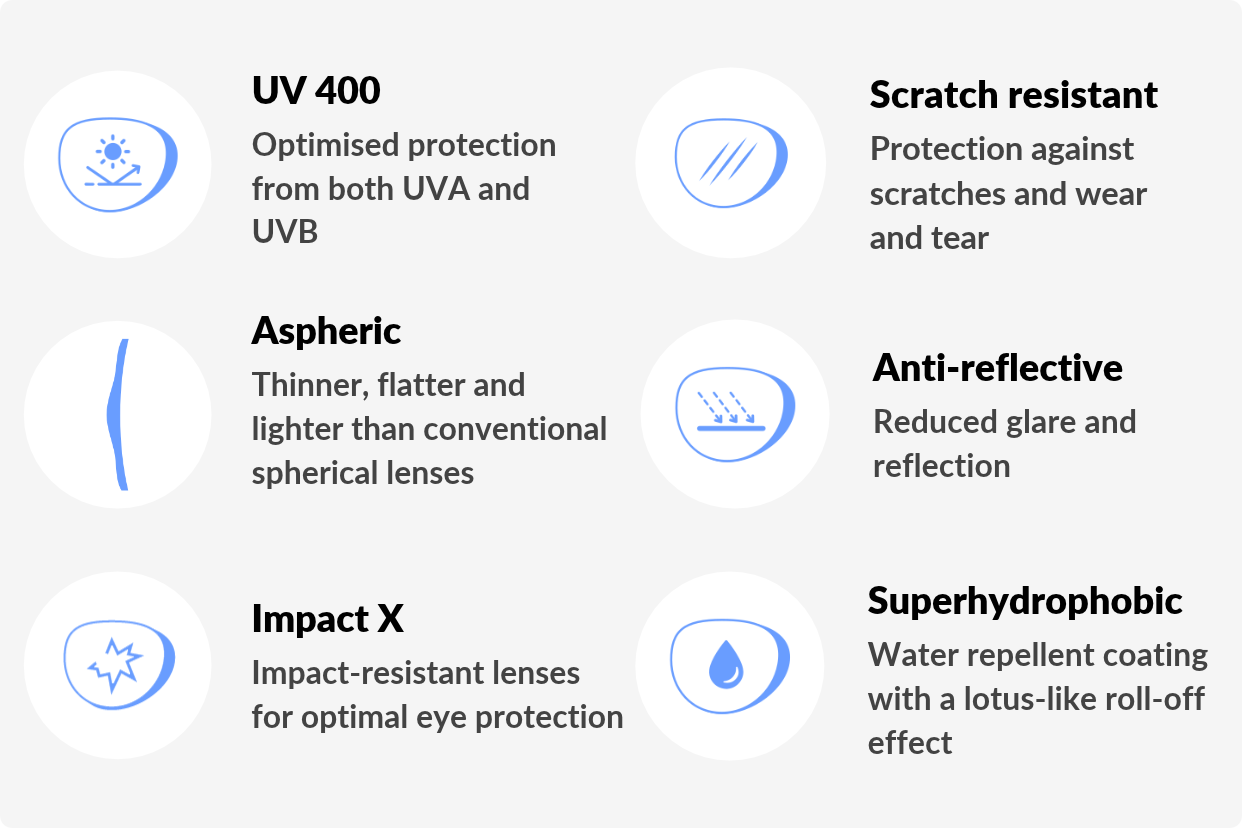
The first table shows which coatings come with each package, and the product page confirms what is included. This is what each coating does.

Feature

What it does

Scratch-resistant coating

Makes the surface harder. It does not make a lens scratch-proof

Anti-reflective coating

Reduces reflections on the lens surface, which helps with glare from screens and night driving

UV400

Blocks UVA and UVB light up to 400 nm

Super-hydrophobic coating

Helps water and smudges slide off

Impact X

Reinforces the lens for added durability. It is not a safety certification

Can I choose varifocal lenses?

Yes. Varifocal lenses give you distance, intermediate and near vision in a single lens, with a smooth change between the zones. They are available in all nine packages (Essential and Clarity), and every varifocal package has an extra cost, including Standard.

Our Arise Collective™ Clarity varifocal lenses offer up to a 30% wider viewing field than standard varifocals, which can make them more comfortable and quicker to adjust to when you look between distance, intermediate and near.

The lens needs enough height to fit all three zones, so aim for a lens height of at least 28 mm. This is a general guide, so check the product page or ask one of our dispensing opticians about a specific pair. Frames that are too wide for your face can also cause distortion at the sides of the lens. To see only the frames that can take a varifocal prescription, use the progressive filter on our designer glasses page.

For varifocal sunglasses, you can add tints, polarisation, a mirrored finish or Transitions® lenses. Our varifocal adjustment guide explains what to expect while you get used to them.

What should I check before ordering?

Check your prescription, your frame and the package details on the product page before you pay.

  1. Frame: check your frame’s lens width, bridge and height against the size guide.
  2. Usage: choose the type of lenses you need. The options are distance, varifocal, reading, occupational (for computer work and arm’s-length distances) and non-prescription.
  3. Prescription: enter it manually, choose it from your account, upload an image of it or send it after you place your order.
  4. Lens: choose your package and compare the index, including coatings and extra cost.
  5. Add-ons: after you choose your lens package, choose zFORT® Blue Light, Transitions®, tint, polarised or mirrored options if you want them.
  6. If anything is unclear, ask a dispensing optician before you order, using the “Speak with one of our opticians” link on the lens page.

The Lens Hub has guides to individual coatings and options. For example, see our guide to scratch-resistant coatings.

FAQs

Do higher-index lenses always cost more?

Within each range, yes. The extra cost goes up with the index, and Clarity costs more than Essential at every index.

Is the price shown for lenses only or for the whole pair?

It is the extra cost of the lens package, on top of your frame. The Standard single-vision lens is included, so it shows as no extra cost.

Can I add Transitions® or polarisation to any package?

Yes. You choose add-ons at the last step of checkout, after you pick your package.

Is a Clarity lens scratch-proof?

No. Clarity lenses include a scratch-resistant coating, which makes the surface harder, but no lens is scratch-proof. Store your glasses in a case and clean them with a microfibre cloth.

Related articles

How Much Are Prescription Glasses?
There are a lot of variables onvolved when buying prescription glasses, so prices can vary. This guide will help you...
View more
Spherical Aberration
Spehrical aberration is when light rays pass through a spherical lens and do not all converge on the same point,...
View more

Leave a comment

Your email address will not be published. Required fields are marked *