





How to test blue light glasses and understand the results

Reviewed by
Maria Horan
What is blue light?
Blue light is high-energy visible light with a short wavelength, roughly between 380 and 500 nm. Screens, LED lighting and sunlight all emit it. Testing shows how much of this range a lens lets through, which is a separate question from whether any particular light is harmful.
If you’re not sure if your glasses offer blue light protection, simply grab a sheet of white paper and go outside with natural daylight and place your glasses over the white paper. If blue light protection is present the paper should show a slight yellow color on it.
If this does not happen, feel free to send us a photo or video of you conducting this test and we can further investigate this for you.
How to check what your lenses filter
Start with the lens, not the frame. Ask the seller or manufacturer for the specification of your exact lens: its name, material and coating. If they can also share a transmission report for that lens, even better.
What a transmission report shows
A transmission report comes from a laboratory. The lab passes light of each wavelength through the lens and records how much gets through. Wavelength is measured in nanometres (nm), and high energy visible blue light sits roughly between 380 and 500 nm. Transmission is the percentage of light that passes through the lens. At 100%, nothing is filtered. The lower the number, the more light the lens holds back at that wavelength.
The laboratory measurement is usually made with a spectrophotometer, which produces the spectrum report described below.
A useful report should include:
What to look for | Why it matters |
|---|---|
Lens identity (name, material, coating) | Tells you the report describes the same lens you’re buying or wearing, not a similar one. |
Laboratory | Shows who carried out the measurement. |
Test date and method | Lets you check how the lens was measured and how recent the result is. |
Wavelength (nm) | Shows which part of the spectrum each reading refers to. |
Transmission (%) | Shows how much light passes through at that wavelength. |
Reading a single number
A report usually plots transmission across many wavelengths, so you see a curve rather than one figure. That matters, because a single reading only describes one wavelength. For example, one SmartBuyGlasses lens transmits 0% of light at 380 to 400 nm, 30% at 400 to 420 nm, and 100% at 450 to 500 nm. That is what this lens does in those ranges. It says nothing about eye strain, sleep or eye health. For a fair picture, look at the readings across the blue part of the curve and check they belong to your lens.
What you can check at home, and what it can't tell you
Home checks are quick, and they can be fun to try. They can also point to a coating or a tint. What they can’t do is give a definitive answer, because a visible tint or reflection only shows that something is on the lens. It doesn’t show which wavelengths the lens filters, or how much.
Check | What you might see | What it can’t tell you | Next step |
|---|---|---|---|
Reflection | Hold the lens at an angle under a lamp or near a window. Some coatings show a blue or purple sheen. | Many coatings reflect colour, including standard anti-reflective ones. A sheen doesn’t show how much blue light is filtered, or at which wavelengths. | Check the product details for the coating name and ask for the specification. |
Tint | Hold the lens over a plain white sheet of paper or a white screen in indoor daylight. Compare it with a clear pair. A faint yellow or amber cast may appear. | Tint depends on the lens material and dye. Some filtering lenses look nearly clear, and a tint doesn’t guarantee a particular level of filtering. | Ask for the specification rather than judging by colour. |
Screen colour demonstration | Display an RGB colour chart, or a pair of black and blue circles, and look through the lens. The blue area may look darker or duller. | Screens, brightness and settings vary a lot. It illustrates a colour change. It is not a pass/fail authenticity check, and it doesn’t measure medical benefit. | Repeat with the same brightness and compare with and without the lens, then ask for the specification. |
In the RGB colour chart demonstration, the blue section may look darker and the green circle slightly dimmer. This illustrates a colour change. It is not a pass or fail test of authenticity.
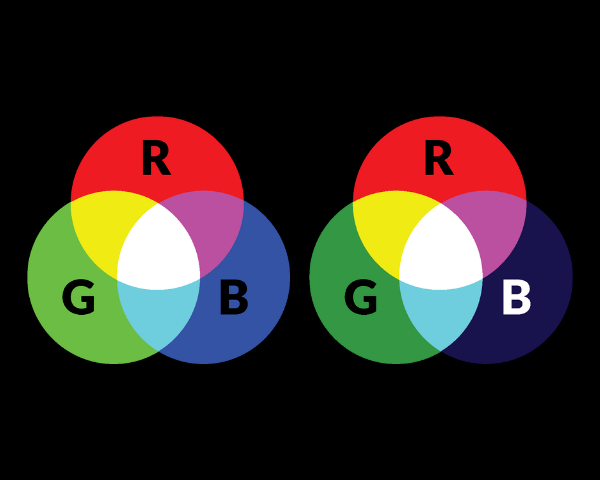
Keep the tint check safe. Don’t point lenses at the sun or look towards it, and there is no need to: indoor daylight and a white background show you everything this check can show. UV-reactive cards are another one you may come across. They react to ultraviolet light, so they can’t tell you anything about the visible blue range either.
Why some blue light glasses look clear and others look yellow
If you’ve compared two pairs and wondered why they look so different, you’ve hit one of the most common questions about these lenses. Blue light filtering can come from a coating, from a tint or dye in the lens material, or from both. A coating can be almost invisible, sometimes with a faint blue or purple reflection. A tint is easier to see and often looks yellow or amber. Through any lens that filters blue, white objects can look slightly yellow, because some blue light has been removed.
A deeper tint can absorb more light overall, blue included, and it can also change how colours look through the lens. That can matter if you do colour-sensitive work. But depth of colour isn’t a score. Two lenses with a similar tint can filter differently, and a nearly clear lens can filter well. So looking different doesn’t make a pair real or fake. Not all coloured lenses filter blue light effectively. Whether a lens filters depends on the science behind its tint and coating, not on how dark or coloured it looks. Only the specification can tell you what a lens does.
Tests to avoid: the blue light pen
Some blue light glasses arrive with a test kit: a small pen and a white card. The instructions claim the pen gives off blue light, and that the card will look blue when you shine it on. In these demonstrations, you shine the pen at the card until a glowing mark or pattern appears, then hold the lens between the pen and the card. If the mark disappears, the demonstration suggests that the lens is blocking the light. Please don’t rely on it as a reliable test of blue light filtering.
A pen can’t measure a lens. It shows that a light source is switched on and that a card reflects it. Neither tells you how much of the visible blue light range your lens transmits.
Whatever you test with, never shine a pen, laser or bright torch directly into your eyes, or through a lens into your eyes.
Filtering is not the same as a health outcome
Measured transmission answers one question: how much light passes through the lens at each wavelength. Whether that changes how tired your eyes feel, how well you sleep, or the long-term health of your retina is a separate question. There isn’t yet enough evidence to establish whether blue light filtering lenses affect the long-term health of the retina.
The evidence here is limited. A Cochrane review found that blue light filtering lenses may not reduce short-term eye strain from computer use, and their effect on sleep remains uncertain. If your eyes feel tired after screen time, an eye examination is a better first step than a filter, because your prescription or working distance may be part of the picture. For practical habits and a wider look at options, see our guide to computer glasses and our advice on digital eye strain.
Conclusion
Testing blue light glasses comes down to one reliable step: getting the specification, or a transmission report, for your exact lens. Home checks can be a curious way to see a colour change, but they can’t confirm what a lens filters, and a pen test can’t either. Once you know what your lenses filter, you can decide whether the filter is worth having for you.
Not sure how to read a report or which lens details to ask for? Speak with one of our dispensing opticians, and they’ll be happy to help. You can also browse more eyeglasses tips in our Optical Centre.