Ask our dispensing opticians

Ask Now

How Do You Know What Strength Reading Glasses To Get?

By Ivana Yankova
Reviewed by Beck Jinnette

Beck Jinnette

Reviewed by

Beck Jinnette
Beck has over 17 years of experience in eye care, holding her Certificate IV in Dispensing in Australia.
Struggling to see clearly up close? Discover how to find the perfect reading glasses strength for you.
woman struggling to read a book because of wrong reading glasses

Have you noticed yourself squinting at your phone or struggling to read a menu at your favourite restaurant?

While it’s common to need reading glasses as we get older, younger people can also benefit from them due to prolonged screen time or other factors. 

Understanding how to choose the right strength reading glasses can make everyday tasks much easier and more enjoyable, regardless of your age.

Do I need reading glasses?

If you’re starting to notice that reading books and holding your phone at arm’s length is becoming a daily practice, you might be experiencing the first signs that you need to wear reading glasses.

As their name suggests, reading glasses are designed to help with near vision, allowing you to see objects up close and perform tasks that require a focused eye.

As we age, our eyes undergo natural age-related changes. One common condition is presbyopia, which typically affects people in their early to mid-40s.

Presbyopia is the gradual loss of your eyes’ ability to focus on nearby objects. It happens because the lenses in your eyes become less flexible over time, making it harder to adjust your focus for different distances.

If these symptoms sound familiar, it might be time to consider getting reading glasses. They can help alleviate the strain on your eyes and make close-up tasks much more comfortable.

How to understand reading glasses strength

Reading glasses come in various strengths, measured in diopters, typically ranging from +1.00 to +3.50. 

The lens strength you need depends on how much assistance your eyes require to focus on close objects. The higher the numbers, the stronger the lenses.

Reading glasses always have a “+” symbol before their strength number. We offer a large range of strengths, from +0.25 to +4.00, to suit everyone’s vision needs.

Why the right reading glasses strength is so important

Wearing the correct strength reading glasses is crucial for comfortable and effective vision correction.

man rubbing his eyes because of wrong reading glasses strength

Using glasses that are too weak or too strong for you can cause blurry vision, eye strain, frequent headaches and even worsen your vision over time. 

It’s like wearing shoes that don’t fit – they might work for a short while, but eventually, they cause discomfort and problems.

How to find the right reading glasses for you

Finding the right reading glasses involves understanding your vision needs and testing different strengths. 

Consulting an optometrist can eliminate guesswork and ensure you get the most suitable glasses.

However, before you book your appointment, here are 3 ways to determine if you need reading glasses:

At-home reading glasses test

While an at-home test isn’t the most accurate way to determine the correct reading glasses strength, it can still provide a helpful starting point. 

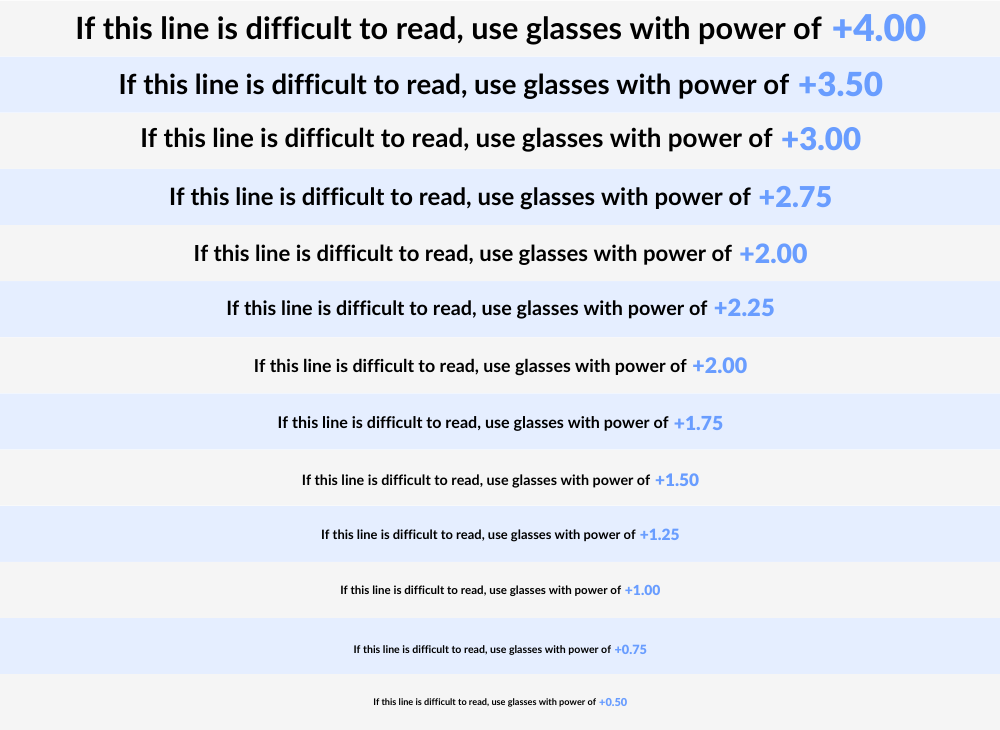
Here’s a simple method you can use with an online reading chart:

  • Step 1: Print out a reading chart or use the one below

  • Step 2: Position yourself in front of your computer, about an arm’s length from the screen. Ensure your screen brightness is set to a comfortable level to avoid additional eye strain.

  • Step 3: Start from the top and try to read the smallest print you can without straining your eyes. Perform this step one eye at a time. First, cover one eye and see which line is most readable. Then, do the same with your second eye. 

  • Step 4: Once you hit a row that you can read easily, take a note of the corresponding glasses strength number. It is possible that your eyes may have mismatched numbers.

  • Step 5: If possible, repeat the test with different charts to confirm your result.

reading glasses chart at-home eye test

Remember, this method offers a general idea of your reading glasses strength, but for the most precise results, we recommend visiting an optometrist for a comprehensive eye exam.

Choose reading glasses strength 'by age'

As you get older, the lens in your eyes changes, and you might need stronger reading glasses. 

Here are general guidelines for reading glasses strength by age (this may differ if you already wear prescription glasses):

  • Ages 40–49: +0.75 to +1.50 diopters
  • Ages 50–59: +1.50 to +2.25 diopters
  • Ages 60 and up: +2.25 to +2.75 diopters

It is recommended that your first pair of reading glasses have a lower diopter. As you age and notice text becoming harder to read, you’ll need to increase the strength of your glasses. 

Regular eye exams can help you keep your glasses up to date. 

DID YOU KNOW?

The average person spends about 7 hours a day on digital devices, which can increase the need for reading glasses.

Choose reading glasses strength in person

Buying reading glasses in stores or over the counter allows you to try different strengths and find the best fit. 

prescription glasses and reading glasses in a store

If there are any, use in-store reading charts or bring your own reading material to test the glasses. 

Don’t hesitate to ask staff for assistance to ensure comfort and proper fit.

Different types of reading glasses

The most common type of lenses for reading glasses are single-vision lenses. In this case, both lenses have the same power. 

Multifocal/varifocal lenses, on the other hand, have multiple prescriptions in one lens, which makes it easier to switch between seeing close up, in between and far away.

Varifocal lenses are the best choice for those looking to correct more than one problem, while single-vision lenses can be a good option if you need the same power for both eyes and only have one prescription.

And if you spend a lot of time in front of screens, adding a blue light block to your lenses can make a big difference by reducing eye strain, fatigue and headaches.

Do reading glasses help with astigmatism?

Although the symptoms of astigmatism and presbyopia may seem similar, reading glasses cannot help all individuals with astigmatism. It is important to remember that generic reading glasses only magnify whatever you look up close.

woman reading a book and wearing correct reading glasses

People with astigmatism may also be nearsighted or farsighted, so reading glasses are not advised if you suffer from astigmatism. To determine whether you have astigmatism, we advise seeing an eye professional.

My glasses don't work, what do I do?

If you’re already wearing reading glasses and have difficulty reading, you probably need to update to a new pair, especially if you got your readers a long time ago.

Just like us, our eyes age as well, which is the most common reason for an increased diopter.

The best solution is to head to your local optometrist and get an eye test to get the perfect pair of reading glasses for you.

If you’re struggling to find the correct reading glasses for your vision needs, it’s always best to visit your eye doctor.

Finding the right reading glasses for your needs

Finding the perfect reading glasses doesn’t have to be a daunting task. 

By understanding your specific vision problems and considering options like at-home tests or in-store trials, you can discover the right strength to enhance your clarity and comfort. 

Remember, the goal is to make your daily activities more enjoyable and strain-free.

If you’re interested in exploring more eye-related topics, be sure to check out our Optical Centre.

Related articles

The Benefits of Polarised Sunglasses
Learn what polarised lenses are, how they work, and who should use them.
View more

Related articles

The Benefits of Polarised Sunglasses
Learn what polarised lenses are, how they work, and who should use them.
View more

Leave a comment

Your email address will not be published. Required fields are marked *