Ask our dispensing opticians

Ask Now

What Are Varifocal Lenses?

By SmartBuyGlasses Editorial Team
Reviewed by Maria Horan FBDO

Maria Horan FBDO

Reviewed by

Maria Horan FBDO
Maria holds a BSc Honours in Ophthalmic Dispensing and has over 17 years of optical experience.
Not sure if varifocal lenses are what you need? Here's the short answer, plus all the key details to help you decide.

Overview

Varifocal lenses correct near, intermediate and distance vision in a single lens, with no visible lines between the different prescriptions. They’re often the solution people reach for once presbyopia (the natural, age-related loss of near focus) sets in, since they remove the need to switch between reading glasses and everyday glasses throughout the day.

You’ll sometimes see varifocal lenses called progressive lenses or multifocal lenses. In the UK, these terms are generally used interchangeably and mean the same thing: a lens with a seamless gradient of varying optical powers, allowing clear vision at different distances. It’s worth knowing that “multifocal” is actually the broader umbrella term, so not every multifocal lens works the same way.

How do varifocal lenses work?

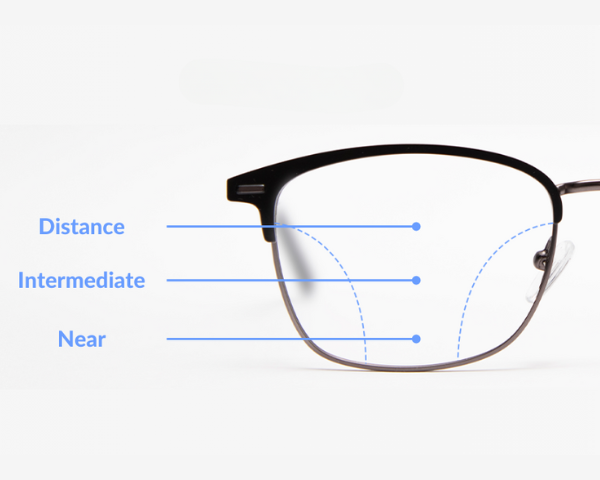
Each part of a varifocal lens supports a different viewing distance. 

  • The top zone corrects distance vision, for things like driving or walking. 
  • The middle zone handles intermediate vision, the kind you use for a computer screen or the dashboard of your car. 
  • The bottom zone is for near vision, for reading or checking your phone. 

These zones transition smoothly into one another, so you can move between them without switching glasses.

In practice, that means a single pair of varifocals can carry you through a normal day. 

Look up and across the room to catch the news on the TV. Glance down slightly to read the laptop screen on your desk. Drop your gaze further to check a text message or read a paperback. 

The lens does the adjusting, not you.

Who should consider varifocals

Varifocals tend to make the most sense once you’re juggling more than one prescription, most commonly because of presbyopia, the natural, age-related change where the eye’s lens gradually loses flexibility and struggles to focus up close. 

It’s worth saying plainly: it happens to everyone eventually, even people who’ve had perfect vision their whole life. 

Beyond presbyopia, varifocals may suit you if:

  • You already wear glasses for distance but now also need help with reading or close work
  • You want one pair of glasses to cover every task, rather than switching between two or three
  • You find the visible line on bifocals distracting, or you’d rather avoid the “image jump” bifocals cause when you shift focus
  • You experience eye strain when moving between near and far tasks

Common signs include needing to hold reading material farther away, eye strain or headaches during near work, and blurry vision at close range.

Is it worth getting varifocal lenses?

If you need correction at more than one distance and want one pair for everything, varifocals are usually worth it. Whether they suit you depends on how often you switch between near and far, and how much adjustment time you can allow.

What you gain:

  • One pair covers your phone, your screen and the room, so you stop swapping between distance and reading glasses.
  • No visible line, and none of the “image jump” you get when your eyes cross a bifocal boundary.
  • Focus changes smoothly as you move your gaze from the top of the lens to the bottom.

Potential Drawbacks:

  • Adjustment time. Peripheral blur is normal at first, and how long it takes to settle varies from person to person.
  • Width. The clear area at the sides is narrower than in a single-vision lens, so you turn your head more.
  • Price. Varifocals cost more than single-vision lenses, and the tier you choose changes the price again.
  • Fixed screen work. If you mostly sit at one screen distance, an occupational lens may do the job better.

One way to judge the cost: compare one pair of varifocals with the two pairs you would otherwise need. Our varifocal lenses start from £79. Your optician can tell you whether your prescription and daily tasks justify the step up.

An eye exam is the reliable way to confirm whether varifocals are right for you and to get your prescription measured properly.

Varifocal vs bifocal vs single vision vs occupational lenses

Lens type

Viewing distances

Typical uses

Limitations

Varifocal

Near, intermediate and distance vision in one lens

Reading a phone, working at a computer, shopping and driving (if prescribed for distance)

Takes some adjustment time, and the usable width narrows toward the edges of the lens

Bifocal

Distance and near only, as two distinct prescriptions

Reading a book or phone while also seeing signs or people across a room

Visible boundary line and noticeable “image jump” between the two zones

Single vision

One distance only (e.g. just reading, or just driving)

Reading, using a computer, driving or watching TV, depending on the prescription

Does not cover other distances, so you may still need a second pair

Occupational (office/computer)

Intermediate and near, not distance

Working at a computer, reading documents or using a second monitor

Not suitable for driving or general distance use

Varifocal vs bifocal vs single vision vs occupational lenses

At SmartBuyGlasses, we offer two varifocal lens ranges: Essential and Arise Collective™ Clarity. Both give you a 3-in-1 lens with no visible lines and clear vision at all distances; the difference comes down to viewing area, adaptation time and durability.

Lens tier

What’s included

Best suited for

Limitations

Price range

Essential

3-in-1 lens, transparent with no lines, clear vision at all distances

A straightforward, everyday option, or a good starting point if it’s your first pair of varifocals

Smaller viewing area and longer adaptation than Arise Collective™ Clarity 

£79  – £209

Arise Collective™ Clarity

Everything in Essential, plus a 30% wider viewing area, quicker adaptation time and Impact X coating

Long hours at a screen, a more complex prescription, or wanting extra comfort and durability from day one

Higher starting price than Essential

£99 – £229

Each tier also has a few different packages within it that vary by lens thickness, coatings and price. If you’re not sure which tier or package suits your prescription or lifestyle, our certified optical experts can talk you through it.

How to order varifocals

Ordering takes a few minutes, and you can do it all online.

  1. Choose your frames. Filter by brand, colour, shape, material and size. Our size guide helps you avoid a frame that fits badly, and for varifocals the frame needs to be deep enough for all three vision zones.
  2. Select varifocal as your lens type. Click “Choose Lenses” on the product page and pick Varifocal from the options. You can read more about it in our varifocal lens hub.
  3. Enter your prescription. Upload a file, type it in, or use details saved to your SmartBuyGlasses account. You’ll need a valid prescription. If you don’t have it to hand, you can send it later and still place your order. If your last eye test was more than two years ago, book a new one first.
  4. Add your pupillary distance (PD). Don’t know yours? Use our PD tool, or read our PD guide first.
  5. Pick your lens package. Packages combine lens thickness (index) and coatings, so choose the one that suits your prescription and daily routine.
  6. Select any add-ons, such as tints and extra treatments, then check out. Our Lens Hub covers all the options.

Fit matters just as much as the lens tier you choose.

Varifocals rely on two precise measurements. The first is your pupillary distance (PD), the distance between your pupils, which keeps each lens centred in front of the correct eye. Our PD guide shows how to measure it. The second is fitting height, which sets where the near, intermediate and distance zones sit in each lens relative to your eyes. Together they help you use all three zones comfortably.

Ready to choose? Browse frames that work with varifocal lenses, then add varifocals at checkout.

Adjustment and common questions

Adaptation varies; speak to your optician if it doesn’t settle. A few habits make that transition smoother:

  • Move your head, not just your eyes, when you change focus
  • Point your nose at what you want to see to stay in the clearest part of the lens
  • Look down with your eyes for reading, straight ahead for intermediate distance tasks like using a screen, and through the top portion for distance tasks like driving.
  • Wear them consistently and avoid switching back to your old glasses, even for a few hours, since that slows down how quickly your brain adapts

If things still feel off after two weeks, speak to your optician. A small adjustment to the fit, frame or prescription can often solve it.

If things still feel off after two weeks, speak to your optician. A small adjustment to the fit, frame or prescription can often solve it.

Why do the edges feel blurry at first? Varifocals blend several prescriptions into one lens, so there’s a bit of peripheral blur while your eyes learn to find the clearest “corridor” through the middle. This usually fades with consistent wear.

Can I wear varifocals for driving or sport? Yes. Tell your dispensing optician about your main activities so the lens design can be tailored around them.

Still finding the peripheral blur or head positioning tricky after a couple of weeks? Our adaptation guide covers troubleshooting in more depth.

Varifocals take a little patience at first, but for most people the payoff is straightforward: one pair of glasses that keeps up with everything from a book to a motorway. If you’re still weighing up whether they’re right for you, our certified optical experts are happy to talk it through.

Related articles

Ask an Optician: Why Do My Varifocals Feel “Off”?
Learn how the adaptation of varifocals happens, the most common fit and prescription issues, and the simple adjustments that can...
View more
Varifocal Lens Sunglasses
A quick guide to varifocal sunglasses and how to choose the right pair.
View more

Leave a comment

Your email address will not be published. Required fields are marked *