





What is Pupillary Distance and How Do You Measure it

Reviewed by
Maria Horan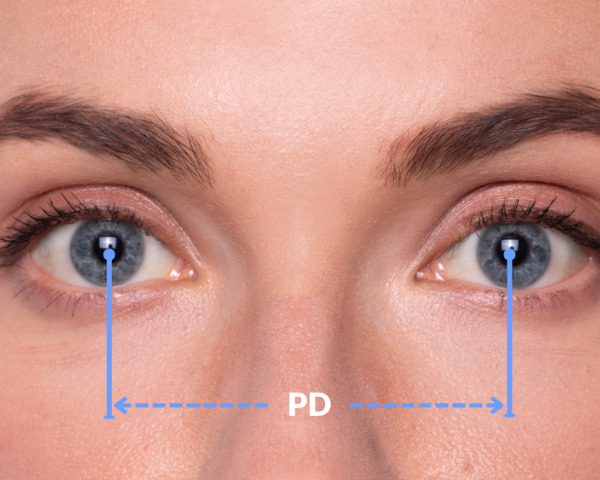
What is pupillary distance?
Pupillary distance, or PD, is the distance between the centres of your pupils, measured in millimetres. Your optician uses it to work out where each lens should sit in front of your eyes.
Picture a pair of binoculars. If the eyepieces don’t match the gap between your eyes, everything looks slightly off and your eyes soon complain. Glasses work on the same principle. The optical centre of each lens, the spot where your prescription does its job, needs to line up with your pupil.
You’ll see PD written in two ways on a prescription. A single PD (also called binocular PD) is one number covering the whole distance from pupil to pupil. A dual PD (also called monocular PD) gives two numbers, one for each eye, measured from the middle of your nose bridge to the centre of each pupil. We look at how the two compare in the single vs dual PD section below.
Why an accurate PD matters
A lens is only as good as its position. Each one has an optical centre, and your PD tells the lab where to put it so it sits right in front of your pupil. When the two line up, you look through the part of the lens that was made for you. When they don’t, you’re looking through a slightly different part, and your eyes may have to work harder to compensate. That can show up as blurred vision, tired eyes or headaches.
The effect tends to matter more with stronger prescriptions and with varifocals, where the different viewing zones leave less room for error.
How PD differs from SPH, CYL and your other prescription values
Most of the numbers on your prescription describe how strong each lens needs to be. PD is the odd one out. It says nothing about strength. It tells the lab where the lens goes.
- SPH (sphere) is the main power of the lens. It corrects short-sightedness or long-sightedness and is measured in dioptres, the unit opticians use for lens strength.
- CYL (cylinder) and axis correct astigmatism, which happens when the front of the eye is shaped more like a rugby ball than a football. CYL is the extra power needed, and axis is the angle it applies at.
- ADD (addition) is the extra power for close-up focus, which you’ll see on reading and varifocal prescriptions.
If any of those terms are new, our guide to reading your prescription walks through each one.
Put simply, SPH and CYL describe what your lenses do, and PD describes where they do it. Getting one right doesn’t make up for getting the other wrong. And PD can be written in more than one way, which is where single and dual PD come in.
Single vs dual PD
Your PD can be written as one number or two, and both describe the same thing.
A single PD is the full distance from the centre of one pupil to the centre of the other. A dual PD splits that distance in two, giving you one measurement for each eye, taken from the middle of your nose bridge to the pupil. Add the right and left values together and you get the single PD.
Faces are rarely perfectly symmetrical, so the two halves often differ. Here is an example:
PD type | Example | What it means |
Right PD | 31 mm | Centre of nose bridge to your right pupil |
Left PD | 32 mm | Centre of nose bridge to your left pupil |
Total (single) PD | 63 mm | Right and left added together |
These numbers are only an illustration. Your own may be different, and that’s fine.
Dual PD is often used for varifocals and stronger prescriptions because it places each lens more precisely. If your prescription gives you only a single PD, don’t simply split it in half. A 63 mm single PD could be 31.5 and 31.5, but it could just as easily be 31 and 32, and that difference can matter.
Entering your PD at checkout
When you order, the prescription details step asks for your single PD in one box or two if you tick the box that reads “I have two PD values”. If your prescription gives a PD for each eye, tick the box and choose your right value in Right PD and your left value in Left PD.
Distance PD vs near PD
Your pupils don’t stay put. Look at something far away and your eyes point almost straight ahead. Bring a book up close and they turn slightly inwards, a bit like crossing your eyes a little. Because of that, the gap between your pupils gets slightly smaller.
That gives you two measurements:
- Distance PD is taken while you look at something far away, such as across the room or down the street.
- Near PD is taken while you look at something close, such as a book or a phone at reading distance.
Which one you need depends on what the glasses are for. Everyday glasses for seeing across a room and reading glasses for a book or a laptop are used at different distances, so they can call for different PD values. Your optician will tell you which applies to your prescription.
There is no single PD that suits every pair of glasses. The right one depends on what you’ll be using your glasses for, and your order should say which kind it is. If your prescription doesn’t make that clear, reach out to our dispensing opticians for help. It’s much easier to check before you order than after.
Don’t work out a near PD yourself by taking a few millimetres off your distance PD. You may see that shortcut online, but the difference varies from person to person, so a fixed subtraction is a guess and not a measurement.
How to get a reliable PD measurement
Getting a measurement you can trust matters more than getting one quickly. These are the routes, starting with the most reliable.
1. Ask a dispensing optician
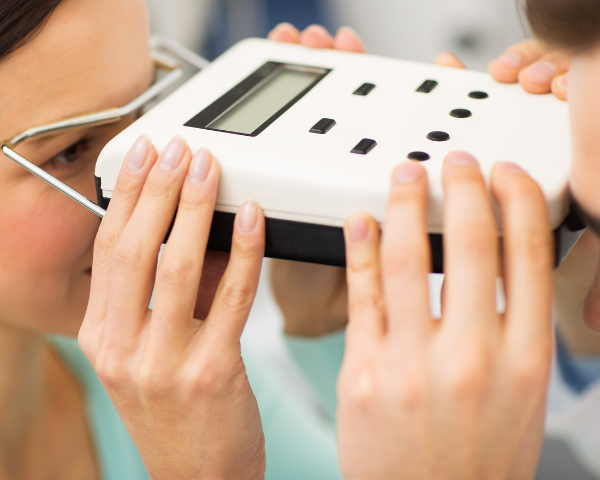
This is the best place to start. An optician can measure your PD in person during an eye test or a visit to a practice, and can take both distance and near measurements if you need them. If you wear varifocals, have a strong prescription or have been told your prescription is unusual, this is the route we’d recommend.
If your prescription doesn’t list a PD, ask for it when you collect your prescription. It only takes a moment.
2. Use our PD tool
If you can’t get to an optician, our PD measurement tool uses your device’s camera and walks you through the steps. You can enter the result when you order.
A few things help the reading:
- Take the measurement more than once. Readings that match give you more confidence than a single attempt.
- Use the same setup each time: the same lighting, the same distance from the screen and the same head position.
- Look straight ahead, not at the screen’s edge.
Common PD mistakes and what to do about them
Most PD problems come down to a handful of slips. They’re easy to avoid once you know what to look for.
Readings that don’t agree. Measure more than once. If your numbers are close, that’s reassuring. If they jump around from one attempt to the next, stop there and don’t pick your favourite. Ask an optician to measure it instead.
Using an average. You may see typical PD figures online, and it’s tempting to use one as a shortcut. Avoid it. Your PD is your own, and a figure that suits most people can still be wrong for you. The same goes for subtracting a fixed amount from your distance PD to guess a near PD.
Mixing up single and dual PD. Check whether each number on your prescription is a total or one eye’s value before you enter it. Putting a total in a field meant for one eye is an easy slip with a real effect.
Choosing the wrong kind of PD. A distance PD isn’t a reading PD. Check that the measurement matches what the glasses are for.
Treating PD as the whole fitting. PD tells us where your lenses sit from side to side. It doesn’t tell us how high they sit, or whether a frame suits your face. For that, opticians use fitting height, the vertical position of the lens in relation to your pupil. This matters most for varifocals, where the viewing zones are stacked from top to bottom. PD doesn’t replace it, and neither does a good frame choice.
Measuring with a ruler and a mirror. It looks easy, but it’s hard to do accurately. The ruler sits a little in front of your face, so the marks don’t line up with your pupils unless you’re looking straight at them from exactly the right angle. Your eyes are also pointing at the mirror or the ruler, a short distance away, so they turn inwards slightly. That can give you a reading closer to a near PD than the distance PD your glasses may need. And when the difference you’re measuring is a few millimetres, a slight tilt or head movement is enough to throw it off. That’s why we suggest a professional measurement or our PD tool instead.
When to stop and ask for help. Stop and speak to an optician if your readings don’t agree, if your prescription has no PD and you aren’t sure which type you need, or if you’re ordering varifocals or glasses for a child.
Children and varifocals: ask for professional help
We’d always recommend a professional measurement and fitting for children, whose PD changes as they grow and who can find it harder to keep still for a reading. The same goes for anyone ordering varifocals. Small errors matter more in both cases, and an optician can check the fit in person.
Conclusion
Your PD is a small number with a big job. It’s the distance between your pupils in millimetres, it can be written as one number or two, and the right one depends on what you’ll be looking at. A professional measurement is the most reliable route, and our PD tool is there if you need it. If you wear varifocals, order for a child or aren’t sure about a reading, asking an optician first will save you time.
If you have any questions, speak with one of our dispensing opticians, who’ll be happy to help. You’ll find more guides to your prescription and your glasses in our Optical Centre.